Varsha Sreekumar
Varsha Sreekumar
Honeywell
Forge
Digital Services
Designed to enhance aftermarket operations for businesses across various Honeywell industries.
ROLE
Lead Product Designer
(I was the only designer for the first year)
Timeline
Nov 2022 - Dec 2024
What is this bundle?
Digital Service Suite
An end-to-end product suite that accelerates the capability of global Honeywell business groups to monetise value from their installed base, while helping customers reduce unplanned costs across their sites.
To start with the product, we had to first identify and validate the problem, find the correct owners for this problem, and map out the ecosystem.
The Core Team
Vice President
Muthu
Senior Directors
Ankur Manke
Mahima
Manish
PM
Ayush Kumar
Sabina
Kamal
Lead UX Designer
Varsha Sreekumar
Technical Product owners
Viji
Vidya
Jabin
Vijay K
Started with mapping the ecosystem
As a first step, I conducted and led a DT workshop for us to filter the ideas, finalise a direction, identify the right areas, and come up with an ecosystem
Started discovery workshop with stakeholders ( Offline & Online )

Glimpse of my work board. Let me know if you want a detailed walk-through of my thoughts.
Mapped the apps & personas and Domains

Mapped the similar customer and user needs identified with all Honeywelldomains


The Outcome: We identified 4 Interconnected apps to execute this Idea
Each serves a different layer of the aftermarket lifecycle.
Product 1 - Step

Admin Portal
We onbaord your customers and you to system here
Persona :- Honeywell Admins
Product 2 - Step
Connect and collect
We onboard your customer's
on- prem assets (machines, sensors, parts etc.) to cloud
Persona :- Honeywell DSP Admins
Product 3 - Step
Detailed case study

Opportunity Tool
For Offering Managers to identify opportunities.
Persona :- Product Managers / offering managers
Product 4 - Step

Customer Portal
Helps customers reduce cost for their sites.
Persona :- Honeywell Customers, C- suite Executives, Process Engineers, Maintenance engineers
Detailed case study
Opportunity Tool for Offering / Product Managers

What is opportunity tool?
Honeywell has a huge customer base with critical assets in the field. Those assets generate large volumes of raw data. But that data is underutilised, because there is no continuous collection, no structured system to analyse it, and no historical record to act on. We need to monetise data from these asset bases for Honeywell's global business.
A little data to backup the claim
$11B
Aftermarket revenue at stake annually
Honeywell's services represent ~30% of total revenue, its highest-margin business. With no tool to identify opportunities inside the installed base, a meaningful chunk of that pool was leaking silently every quarter.
Honeywell Annual Report 2022
<30%
Of aftermarket potential captured by industrial OEMs
Across industrial OEMs, over 70% of available aftermarket value parts, renewals, service upgrades, goes to third parties or disappears entirely.
Without a system to surface it, Honeywell's OMs faced this same structural loss.
SBT Annual Report 2023
23 M
Connected data points, zero actioned for service
23 million data points on the Forge IoT platform.
The data existed at scale, but with no tool to translate it, that infrastructure was generating signal with nowhere to go
Honeywell Annual Report 2023
Understanding who am I building this for
User research and problem validation
1.Got these basic questions filled

2. Identified the personas
Primary : Offering/ Product Managers

3.Site visit to learn about users

4. Interviews with users online
5. Data synthesis and research report out


Persona Redefined


Tools used by my users
-
Tableau
-
Excel sheets
-
Honeywell Internal legacy tools
-
Confluenc
-
External tracker tools of choice.


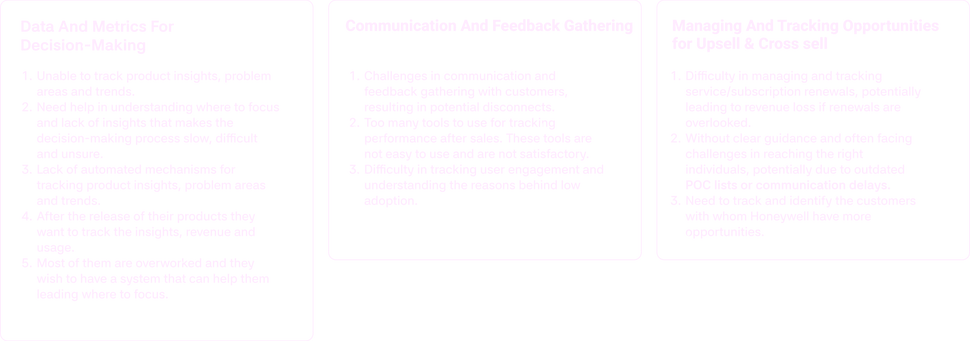
Based on connecting with end users, I found these categories worth considering.
.png)
Towards The Solution
Conceptualisation
I started with creating user journey, experience outcomes, IA and low- fi concepts for the primary use cases. many features were altered based on the tech feasibility. After having go ahead from the business, product and other subject matter experts this was converted to high fidelity for testing. As the plan was to test it with external users. Once we had confidence in the design the dev ready files were completed.
Experience outcomes for each stories

Updated User Journey

Wireframes for my team to check tech feasibility

The Solution: An opportunity tool for Product managers
The nerve centre that tells Product Managers where the money is, who needs attention, and what to do next
Insight 1: Managing and tracking Up-sell and cross-Sell opportunities
.png)
<---- Design after feedback
<---- Design after feedback
1. Overview with needed KPIs
-
Overview of the customer base, including the revenue details in one place.
-
The user has access to all the Issues with a resolution date.
-
The KPIS are aligned with the needs of the SSMs & Offering manager.
Design that I took for user feedback - If you want to see more we can connect
Before
I liked how you are showing the customers into multiple cateogories. We don't use regular in our domain, can we change it ? Also how are you predicting the growth rate ?

The visualisation is refreshing, comapred to what we use.
I am able to understand the data easily, I liked how this has come up
I liked the Issue metrics, It shows me the asset criticality, are you planning to connect this with our BMS systems? How are you pulling the seveirty score and what team will do the
1. We won't need the activity feed here as there will be no daily updates coming up.
2. Will there be a provision for me to have my top customers data who are performing poor ?
3. Can I see what would be the health of my product ? Like if it falling in the planned score or not? (3/5 users*)
After
.png)
Added
Added avg. health score for the user's product
I would be really happy to use this. Will you be able to pull the revenue data from our systems ? Check with the legal team?
The revenue data is what we need exactly. Is there a bad revenue score that you are planning to show? We don't track that yet. Not sure if we can set a revenue goal.
Highlighted issues along with customers to drag the user's attention to the critical users
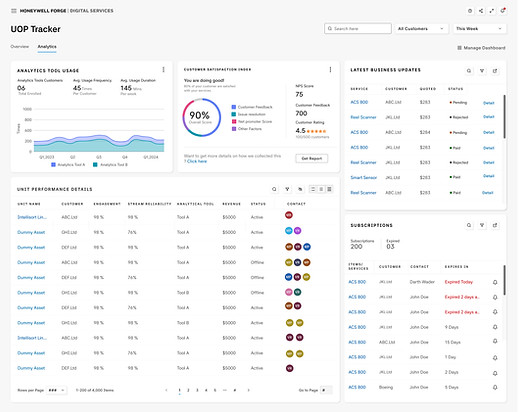
<---- Design after feedback
2. Customer opportunities and satisfaction analysis
-
Analytics tool usage data and customer satisfaction to track user engagement data.
-
The purchase details data and subscription information inform the SSMs & Offering managers about the status of the sold services and the potential services/warranty.
-
This tool lets the user find the respective point of contact responsible for each issue on the customer’s end.
-
The user can also get the feedback recorded directly from the customers, unlike before (They had to switch between multiple dashboards to gather this data).
Removed the activity feed and combined that feature with notifications. A notification settings were also made
<---- Design Upgrade - New feature
2. Customer opportunities and satisfaction analysis
-
We also realized during first few UTs that every user have different priorities in terms of KPIs.
Insights 2 : Detailed Asset 360 Analytics & Root cause, report analysis with AI Recommendation.

1. Asset 360 level details that help the user to understand the depth of the risk.
-
Listing out the opportunities for the offering managers for each customer.
-
The asset 360 details help the SSMs and OMs to provide better products and services to the customers with data.
2. Root Cause Analysis With AI recommendations
-
Based on the type I studied and implemented multiple data visualisation methods and also provided. recommendations to fix it.
-
The recommendations also lead you to the right pages to purchase or contact HW POCs


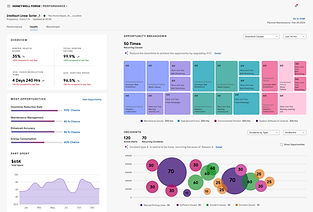

All Domains- Plants, warehouse, buildings

Connected Assets
-
This feature helps the Product Managers to find opportunities with assets that are connected through prediction and helps our customers to make decisions faster.
Only for Aerospace - Business decision

Insights 3 : Asset recommendation and Summary Report for faster decision making + Introduction to Chatbot
-
A glimpse of what the recommendations look like, with evidence on why we think users should be taking some actions. This will help the user to focus on the problem more and troubleshoot less.
-
The Chatbot also helps the user with any questions related to assets and services.


Please connect for a demo of the solution flow in prototype
Other sides of the story
Towards the design system
AI patterns - High level view
Icons and Gradients
Navigating chaos
The map view saga
This created a lot of back and forth, and shows how explaining user psychology and behaviour can shift a strong stakeholder position.
-
Leadership wanted a map view to show all customers for the offering managers.
Challenges
The Tool is already data heavy and having a map for persona will be visually heavy and
How did I solve it
-
We highlighted the need to show the high priority data that will lead the user to take action.
-
The map can make the user spent more time on with too many points since offering managers deal with customers across the globe.
-
The user behaviour and psychology were explained to the stakeholders to convince them.
Impact Measurement
How did the users & business find this solution
Learnings
What this project taught me?
Simplicity enhances impact
-
The most simple solutions are not just aesthetic but impactful and user adoption .
-
The clear the design the stronger the connection. As designers we often tend to deviate and attracted to out of the box and trendy dribble shots. But, we must remember the primary goal of the user and ‘why’ part.
Prioritise
-
Prioritise and create a proper plan for chaotic projects. This helps deal with out-of-scope requests that could potentially derail the project and helps deliver a quality product in time.
Constant communication and collaboration
-
Collaborate and communicate at the right time to be in sync with Business, Products and Dev.